


You’ve probably spent real time reading tampon labels, looking for “organic” or “natural” to feel confident about what you’re putting in your body. But here’s something most labels won’t tell you: organic does not automatically guarantee no metals in tampons. The gap between “organic” and “metal-free” is real, scientifically meaningful, and often glossed over in marketing language. This guide breaks down exactly what metal-free means, how it compares to organic and chemical-free claims, and what you actually need to know to make the safest, most sustainable choice for your cycle.
Table of Contents
- Understanding metals in menstrual products
- ‘Metal-free’ vs. ‘organic’ vs. ‘chemical-free’: Decoding product claims
- Health implications and myths: What current science tells us
- Eco-conscious and comfort factors: Sustainability, transparency, and your body
- Smart shopping: How to identify safe, truly metal-free tampons
- Why the phrase ‘metal-free’ on tampons needs a rethink
- Explore cleaner, safer period care with proven metal-free tampons
- Frequently asked questions
Key Takeaways
| Point | Details |
|---|---|
| Metal-free isn’t guaranteed by ‘organic’ | Even organic tampons can contain trace metals, so look for lab verification. |
| Transparent testing is key | Brands should publish third-party metal tests, not just promise metal-free or organic. |
| Actual health risk is low | Current science does not show meaningful health harm from trace metals in tampons. |
| Eco benefits go beyond metals | Choose products with sustainable sourcing and biodegradable packaging for true eco impact. |
| Comfort and sensitivity matter | Consider your personal irritant triggers and select fragrance/dye-free, well-tested products for best comfort. |
Understanding metals in menstrual products
Now that you know the confusion around labels, let’s get clear on what “metals” even means in period care.
When scientists and health advocates talk about metals in tampons, they are referring specifically to heavy metals. These include arsenic, lead, cadmium, and mercury, among others. None of these belong anywhere near your vaginal tissue, which is one of the most absorbent tissues in the entire body. Yet research has confirmed trace levels of these substances showing up in both conventional and organic tampon products.
How do metals end up in tampons at all? There are three main pathways. First, raw cotton absorbs metals from the soil it grows in, especially if that farmland is near industrial zones or has been treated with certain pesticides over decades. Second, manufacturing and processing can introduce trace contamination if facilities share equipment or use water sources with metal residue. Third, environmental contamination is a background reality for almost all agricultural crops. Cotton is a heavy pesticide crop historically, and those chemicals can carry metallic compounds.
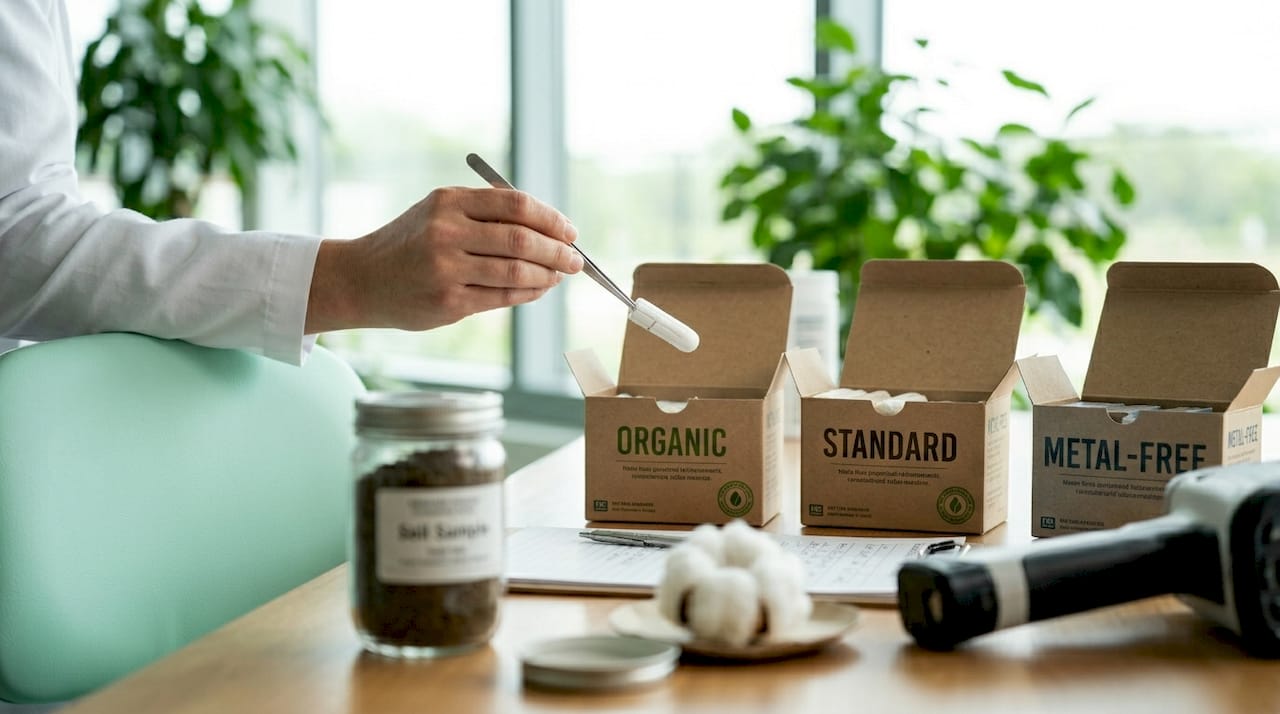
Here’s where the organic myth gets complicated. Arsenic and lead can be found in both conventional and organic tampons, which means certified organic cotton does not guarantee an absence of heavy metals. Organic certification speaks to how the crop was grown, not necessarily to what contamination it absorbed from the soil or surrounding environment before the farm was converted to organic practices.
| Metal | Common source in cotton | Health concern |
|---|---|---|
| Arsenic | Soil and pesticide residue | Neurotoxin, potential carcinogen |
| Lead | Industrial soil contamination | Neurological damage |
| Cadmium | Fertilizers, mining runoff | Kidney and bone toxicity |
| Mercury | Industrial discharge | Neurological effects |
“Finding chemicals in products does not necessarily mean they get into the body at harmful levels.” — The Conversation
This distinction matters enormously. Presence is not the same as exposure. Exposure is not the same as harm. Still, the precautionary principle applies here: if you can choose a product with independently verified lower contamination, why wouldn’t you? Understanding what goes into your chemical-free tampon workflow starts with understanding where raw material risks exist in the first place.
‘Metal-free’ vs. ‘organic’ vs. ‘chemical-free’: Decoding product claims
Once you understand what metals are and why they matter, the next question is: what do all these product claims actually mean, and which should you trust?
These three terms get used almost interchangeably in marketing, but they describe very different things. Here’s a clear breakdown:
Organic means the cotton was grown without synthetic pesticides or fertilizers and is certified by a body like GOTS (Global Organic Textile Standard) or similar. It tells you about farming practices, not final product testing.
Chemical-free is the loosest claim of the three. It generally means the product was processed without added bleaches, fragrances, or synthetic dyes. It does not specifically address heavy metals, which are technically naturally occurring elements, not synthetic chemicals.
Metal-free is the most specific claim and the most meaningful from a contamination standpoint. It should mean the finished product has been independently lab tested and confirmed to contain no detectable heavy metals above safe thresholds. The critical word here is “should.” Metal-free claims should be supported by independent testing rather than organic certification alone. Without that documentation, “metal-free” is just another marketing phrase.
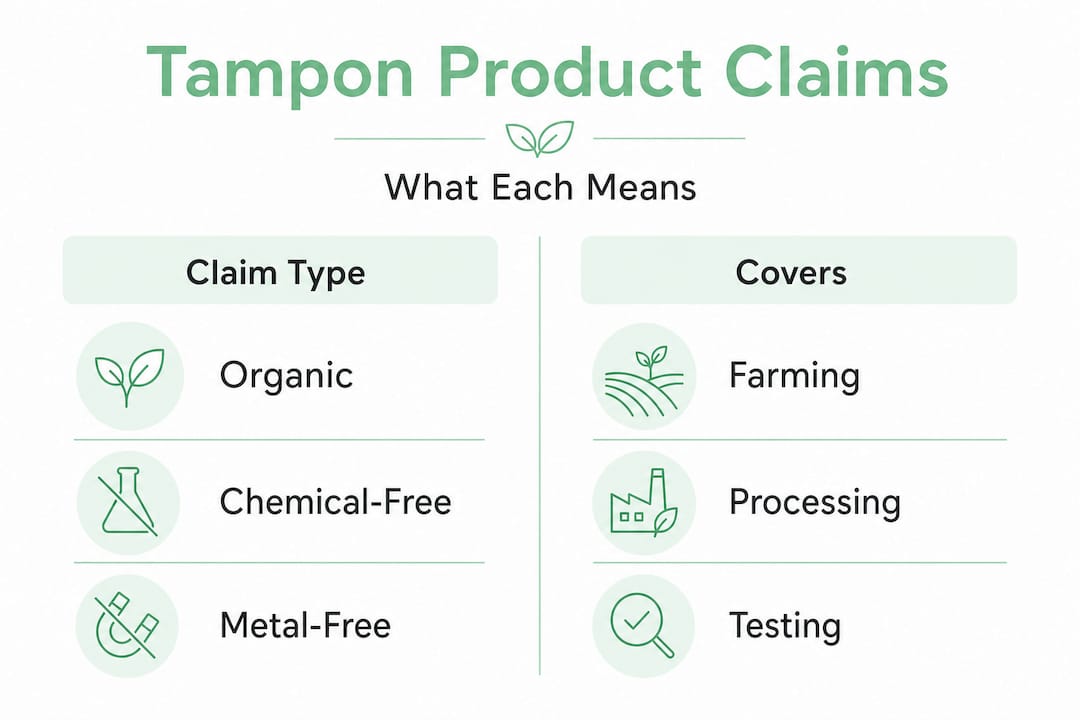
| Claim | What it addresses | Independent testing required? |
|---|---|---|
| Organic | Farming practices | No |
| Chemical-free | Processing additives | Sometimes |
| Metal-free | Heavy metal contamination | Yes (or it means nothing) |
Why do shoppers conflate these claims? Because brands often use all three together, creating an impression that each reinforces the other. Organic or metal-free positioning often aims to reduce chemical inputs and contaminants, but a claim is not the same as a proven health outcome. Read ingredient lists. Ask brands directly for lab reports. Look for published third-party test results on the website, not just a badge or buzzword on the box.
When exploring health-conscious menstrual options, the most empowering thing you can do is learn to ask the right questions rather than trusting that any single certification covers everything.
- Organic certification does NOT equal metal-free
- Chemical-free does NOT equal organic
- Metal-free without documented testing is unverifiable
- Third-party lab reports are the gold standard for any of these claims
Pro Tip: Search for the brand’s test results online or email their customer service asking for their heavy metal testing documentation. A trustworthy company will have this ready and will share it without hesitation.
Health implications and myths: What current science tells us
With claims making the rounds, it’s vital to know what risks, if any, science really supports regarding metals in menstrual products.
Let’s walk through the key science clearly, without panic and without dismissiveness.
-
Presence does not equal exposure. Just because a metal is detected in a tampon does not mean your body absorbs it. The amount, the duration of contact, and the specific form of the metal all influence whether any meaningful absorption occurs during use.
-
Vaginal tissue is highly absorbent. This is a legitimate reason for concern, but it also means the exposure question requires careful study, not assumption. Scientists are still working to quantify actual absorption rates from tampons specifically.
-
No studies have shown direct harm yet. No studies have shown meaningful health harm from trace metals in tampons to date. That is an important caveat. “No evidence of harm” is different from “proven safe.” More research is needed, and ongoing caution is reasonable.
-
Cumulative exposure is a real consideration. Someone who uses tampons for roughly 38 years of menstrual cycles is exposed to far more contact time than a one-off product test might suggest. Long-term, cumulative effects of very low level exposures are harder to study and not yet fully understood.
“Expert-education frames emphasize that finding chemicals or metals in products is different from demonstrating harmful exposure.” — The Conversation
Myth: Organic tampons prevent all toxic exposure. Fact: Organic certification reduces synthetic pesticide residue but does not eliminate naturally occurring metal contamination from soil.
Myth: Any metal in a tampon will cause cancer. Fact: Current evidence does not support this conclusion. Theoretical risks exist with long-term, high-dose heavy metal exposure, but tampon use does not currently meet that threshold in available studies.
Myth: Sensitivity and discomfort are caused by metals. Fact: Most tampon-related irritation comes from added fragrances, synthetic dyes, chlorine bleaching agents, and applicator materials, not from trace metals. If you experience irritation, fragrance-free and unbleached products are often the first practical fix.
Pro Tip: If your body reacts to a tampon, consider ruling out added fragrance and dyes before assuming metal content is the culprit. Unscented, undyed options are a smart starting point. Look into smart choices for health and safety when you want to compare products side by side.
Eco-conscious and comfort factors: Sustainability, transparency, and your body
Beyond health, the eco and comfort angles are where many women find their “why” for choosing metal-free options or genuinely sustainable alternatives.
The sustainability story around organic and metal-free tampons plays out on two levels. Upstream, it starts with the farm. Organic cotton farming eliminates synthetic pesticides and fertilizers, which benefits soil health, local water quality, and biodiversity. Farmworkers face fewer chemical exposures. Pollinators survive. These are genuinely meaningful upstream benefits, even if they don’t directly translate to a metal-free product on the shelf.
Downstream, sustainability benefits come from packaging and material choices rather than from any proven health outcome. Biodegradable cotton tampons, plastic-free applicators, and recyclable or compostable packaging reduce what ends up in oceans and landfills. The “Save the Turtles” ethos is real: millions of applicators wash up on beaches every year, and switching to plastic-free packaging is one of the most direct actions you can take to cut that waste.
Personal comfort is the third dimension here, and it deserves more attention. Women with sensitive skin or vulvar conditions often notice a real difference when switching to fragrance-free, dye-free, and unbleached products. Whether or not trace metals are causing measurable harm, eliminating unnecessary chemical additives simply makes sense for comfort and skin health.
- Organic farming reduces pesticide exposure for farmworkers and ecosystems
- Plastic-free packaging reduces ocean and landfill waste directly
- Fragrance-free and dye-free products reduce irritation risk
- Brands that publish ingredient lists and test results earn trust through transparency
- Biodegradable materials reduce the environmental footprint of each cycle
For practical guidance, reading through eco-friendly menstrual care tips and exploring eco-friendly tampon packaging guides are excellent ways to identify brands that walk their talk. When you’re ready to dig further, resources on sustainable menstruation choices cover the full lifecycle of period products in detail.
Pro Tip: Opt for brands that publish third-party test results on their website and use fully recyclable or compostable packaging. Either commitment alone is good. Both together signals a brand that takes transparency seriously from seed to disposal.
Smart shopping: How to identify safe, truly metal-free tampons
It can feel overwhelming to cut through eco and health claims, so here’s a simple, science-backed framework for picking the safest product for you.
-
Start with brand transparency. Does the company publish their ingredient list clearly? Can you see exactly what is in the cotton and what the applicator is made from? If a brand hides behind vague terms like “purified cotton blend,” that’s a red flag.
-
Search for third-party lab reports. Prioritize products with transparent, independent third-party testing results for heavy metals and other contaminants. These should be available publicly, either on the website or upon direct request. Third-party means tested by a lab that has no financial relationship with the brand.
-
Check certifications, but don’t stop there. GOTS-certified organic cotton is a meaningful credential. OEKO-TEX certification tests for a wider range of harmful substances including some metals. But even these certifications have thresholds and scopes, so they complement rather than replace direct testing documentation.
-
Evaluate your personal sensitivities. Are you prone to irritation? Prioritize fragrance-free and dye-free above all else. Do you react to plastic? Choose cardboard or applicator-free options. Your personal comfort factors should guide your priorities after you’ve verified basic safety.
-
Factor in packaging. A tampon that’s certified organic but wrapped in layers of plastic packaging is not a fully sustainable choice. Look for brands where the commitment to cleaner inputs extends to cleaner packaging outputs.
-
Read reviews for real-world feedback. Lab results tell you one thing; real users tell you another. Look for patterns in reviews around comfort, reliability, and how the brand handles customer questions about ingredient sourcing.
Pro Tip: Don’t stop at “organic” when you see it on a box. That single word tells you only about farming practices. Ask: Is this independently tested? What is the applicator made from? What certifications back the metal-free claim? Understanding the full impact of organic period products gives you the language and context to ask these questions confidently.
Why the phrase ‘metal-free’ on tampons needs a rethink
Here’s a perspective that most period care brands won’t share with you: the label “metal-free” is nearly meaningless without third-party documentation, and the current market lets brands use it freely without that proof.
We hear from so many women who switched to organic tampons believing they had solved the metal contamination concern entirely. They hadn’t. They had made a better farming choice, possibly a better processing choice, but not necessarily a verified metal-free choice. The conflation of “organic” with “clean and completely safe” is one of the most persistent and damaging myths in the period care space.
True health-conscious choices demand documentation, not just claims. You deserve to see the lab report, not just a leaf icon on the box. The uncomfortable truth is that regulators in the United States have not historically required tampon manufacturers to test for or disclose heavy metal content. That regulatory gap puts the responsibility on brands to voluntarily test and disclose, and on consumers to demand it.
Brands that genuinely stand behind a metal-free claim will publish their testing. They won’t make you dig for it. That level of transparency, not the word “organic” or a certification badge, is what actually reflects a commitment to your health and the planet’s health.
If you’re exploring using natural tampons as part of a broader shift toward eco-conscious living, let transparency be your north star. Ask harder questions. Expect better answers. The market will catch up when enough of us do.
Explore cleaner, safer period care with proven metal-free tampons
You now have the tools to read past buzzwords and spot what genuinely matters in period care. The next step is actually shopping with that knowledge.
At Tampon Tribe, we build our products around the exact standards you’ve just read about: independently tested organic cotton, zero plastic packaging, and full ingredient transparency. Our tampons are designed for women who don’t want to choose between personal health and planetary health. Explore our full range of organic, chemical-free tampons and see the certifications and testing that back every product. From applicator-free options to fully compostable packaging, everything we offer reflects a commitment to cleaner periods for you and a healthier planet for all of us.
Frequently asked questions
Are organic tampons always metal-free?
No, organic tampons may contain metals like arsenic and lead, so only independent lab testing can confirm a metal-free claim. Organic certification addresses farming practices, not final product metal content.
Is there any proven health risk from metals in tampons?
No clinical studies have shown meaningful health harm from trace metal exposure in tampons so far. Expert-reviewed summaries confirm that detected chemical presence does not equal harmful exposure levels, though more research is ongoing.
What should I look for when choosing metal-free tampons?
Look for brands that publish transparent, independent third-party lab results for metal testing. Choosing products with transparent third-party testing is recommended over trusting organic claims alone, so always ask for the documentation.
Do metal-free tampons help the environment more than regular ones?
Environmental benefits mostly come from organic farming and sustainable packaging choices. Sustainability benefits are upstream in farming and downstream in packaging material choices, which often accompany metal-free products but are not guaranteed by the claim alone.
Is ‘chemical-free’ the same as ‘metal-free’ with tampons?
No. “Chemical-free” focuses on the absence of synthetic additives like fragrances and dyes, while “metal-free” specifically addresses tested absence of heavy metals. The two claims address different aspects of product safety and should be evaluated separately.