


Many shoppers assume that an “eco-friendly” or “natural” tampon automatically means it was made under fair and ethical conditions. That assumption can lead you to overlook a whole dimension of what makes a period product truly responsible. Fair trade certification and organic or chemical safety certifications actually address entirely different problems, and understanding that gap is the key to shopping with real confidence. This guide walks you through exactly what each label means, where they overlap, and how to use both when you choose your next box of tampons.
Table of Contents
- What does fair trade mean for tampons?
- Fair trade vs. organic and safety certifications
- How fair trade fits into the sustainability equation
- How to shop: applying fair trade principles for tampons
- Why transparency matters more than perfection in period care ethics
- Choose tampons that align with your values
- Frequently asked questions
Key Takeaways
| Point | Details |
|---|---|
| Fair trade supports workers | Fair trade certification ensures tampons are made with ethical labor practices and support for farmers. |
| Combine multiple labels | Look for both fair trade and organic/safety certifications to maximize health, sustainability, and ethical value. |
| Fair trade is about social impact | Fair trade certification complements, but does not replace, eco or health-focused assurances in period products. |
| Transparency matters most | No single label covers everything; focus on transparent brands with detailed sourcing and safety testing. |
What does fair trade mean for tampons?
To understand how fair trade fits into your menstrual product choices, let’s first clarify what the certification actually means in practice.
Fair trade certification focuses on people, not ingredients. Specifically, it addresses the conditions and livelihoods of the farmers and workers who grow and process cotton along the supply chain. When you see a Fair Trade Certified label on a product, it tells you that the producers involved were paid fair prices, had safe working conditions, and that community development funds were built into the purchasing agreement.
What fair trade does not tell you is whether the cotton is organic, pesticide-free, or processed without harmful bleaching chemicals. That is a completely separate question answered by completely separate certifications. Fair trade is a certification and labeling approach aimed at improving conditions and livelihoods for producers in the supply chain, not a tampon-specific ingredient standard. Those are two very different things, and conflating them is one of the most common mistakes eco-minded shoppers make.
Here is what a Fair Trade Certified label typically guarantees when it appears on menstrual products:
- Fair pricing: Farmers receive a minimum price floor for their cotton, protecting them from market volatility.
- Community premiums: A portion of the purchase price goes into a fund that farming communities vote on and use for schools, healthcare, or infrastructure.
- Labor standards: Workers are protected from forced labor, child labor, and unsafe working environments.
- Supply chain transparency: Companies must document and verify their sourcing practices through regular audits.
- Long-term partnerships: Buyers commit to longer-term trading relationships rather than one-off transactions.
“Fair trade certification is about building a system where the people who grow and harvest your cotton can live and work with dignity, not just survive to supply your supply chain.” This distinction matters because it reminds us that ethical shopping has a human face, not just an environmental one.
Notice that nothing in that list mentions pesticide residues, chlorine bleaching, synthetic fragrance, or dioxin byproducts. Those are real concerns for tampon safety, but fair trade simply is not designed to address them.
Fair trade vs. organic and safety certifications
Now that you know what fair trade means for tampons, it’s critical to see how it actually intersects and differs from the organic and safety standards you see on packages.
Two certifications you will often see on premium tampon brands are GOTS (Global Organic Textile Standard) and OEKO-TEX. GOTS certifies that the fiber is grown organically, meaning without synthetic pesticides or fertilizers, and that processing meets strict environmental and social criteria. OEKO-TEX tests the finished textile for over 100 harmful substances, including pesticide residues, heavy metals, and formaldehyde. Neither of these is the same as fair trade, though GOTS does include some labor requirements.
The bottom line is that fair trade benefits complement rather than replace organic and textile safety certifications like GOTS and OEKO-TEX that address chemicals and fiber standards. You need both lenses to evaluate a tampon fully.
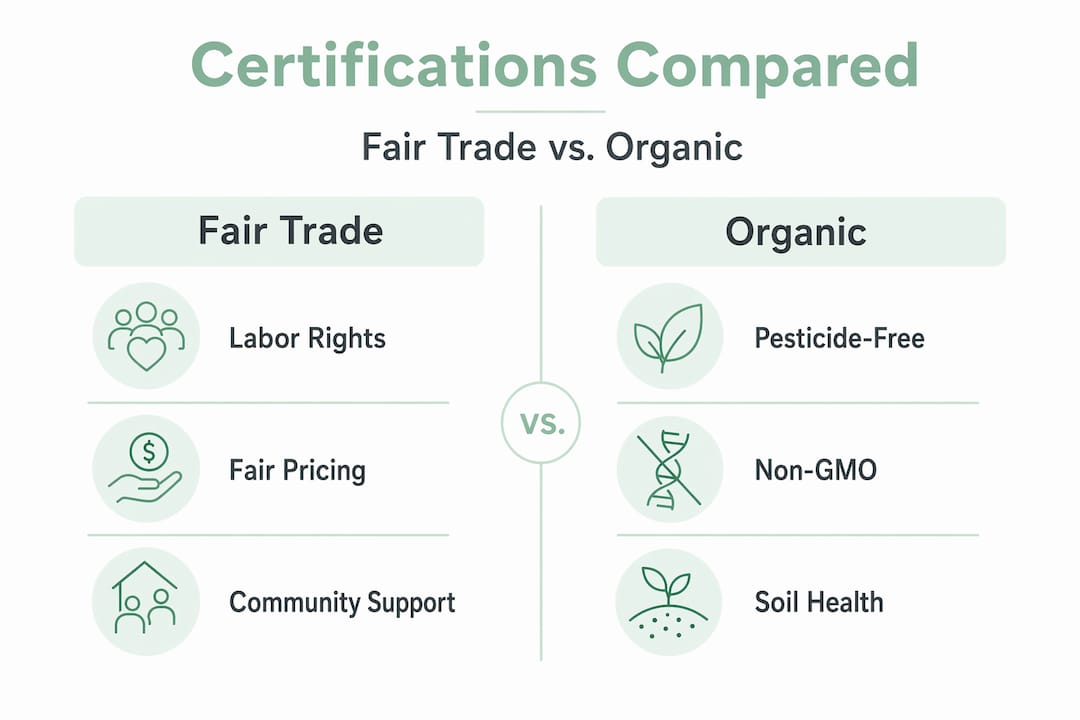
Here is a comparison to make this concrete:
| Certification | What it covers | What it does NOT cover |
|---|---|---|
| Fair Trade Certified | Labor conditions, fair wages, community funds | Pesticide use, chemical processing, fiber purity |
| GOTS (organic textile) | Organic fiber, restricted processing chemicals, some labor | Direct toxic residue testing on finished product |
| OEKO-TEX Standard 100 | Chemical residue testing on finished product | Farming practices, labor conditions |
| USDA Organic | Organic farming standards for cotton | Labor conditions, finished product chemical testing |
Pro Tip: The safest tampon, from both a health and ethics standpoint, would carry certifications from at least two columns: one addressing labor (fair trade) and one addressing material safety (GOTS or OEKO-TEX). Never let one label do all the work.
When you are standing in the aisle or scrolling online, here is a numbered checklist for evaluating any tampon that claims to be ethical or sustainable:
- Check for a recognized third-party fair trade label, not just the phrase “fairly sourced” written in marketing copy.
- Look for an organic fiber certification (GOTS or USDA Organic) that confirms the cotton was grown without synthetic pesticides.
- Search for a textile safety certification (OEKO-TEX Standard 100) that tests for chemical residues in the finished tampon.
- Read the ingredient list, which should be short: organic cotton, and nothing else for a basic tampon.
- Verify the claims by going to the certifying body’s website, where you can search for the brand by name.
For a broader context on why these distinctions matter for your health and the planet, the organic period products guide offers a helpful foundation. You can also use the eco period checklist as a practical shopping tool the next time you need to evaluate a new brand.
How fair trade fits into the sustainability equation
Comparisons aside, you might be wondering how fair trade actually factors into broader sustainability claims and what independent assessments say about its role.
The honest answer is that most formal sustainability benchmarks for period products do not put fair trade at the center. Life-cycle assessments of period products typically measure climate impact, water use, and waste generation across the product’s entire life, from cotton field to landfill. Those metrics matter enormously, and the results often surprise people. A single-use conventional tampon has a much larger environmental footprint than one made with organic cotton, in part because conventional cotton farming is intensely resource-heavy.

Where does fair trade show up in that picture? Mainly in the social column, not the environmental one. Look at this breakdown:
| Sustainability axis | Organic cotton | Fair trade certification |
|---|---|---|
| Pesticide reduction | High impact | Low to no direct impact |
| Carbon footprint | Moderate improvement | No direct improvement |
| Water use | Moderate improvement | No direct improvement |
| Worker livelihoods | Indirect (GOTS has some labor standards) | High direct impact |
| Community development | None | High direct impact |
| Supply chain transparency | Partial | High direct impact |
Pro Tip: Think of fair trade as your “social sustainability” lever, while organic certification is your “environmental sustainability” lever. Pulling only one means you are only solving half the problem.
The period product environmental impacts issue is significant. Studies estimate that the average person who menstruates uses between 5,000 and 15,000 pads and tampons in a lifetime, most of which end up in landfills. The type of cotton used and how it is processed directly shapes that footprint. Fair trade alone does not reduce that waste, but it does ensure the humans producing those products are not paying a hidden cost with their health and livelihoods.
That is unique value. Labor transparency and fair pricing create more resilient farming communities, reduce exploitation in global cotton supply chains, and support sustainable agricultural practices over time. When communities earn fair wages, they are more likely to invest in land care and less likely to resort to environmentally destructive shortcuts. So while fair trade does not score on a carbon calculator, it contributes to long-term sustainability in ways that a life-cycle assessment cannot fully capture. If you want to think through the bigger picture, picking natural period products has solid guidance on how material choices interact with sustainability goals.
How to shop: applying fair trade principles for tampons
With context and comparisons in hand, the next step is applying this knowledge so you can confidently shop for tampons that align with your health, values, and sustainability goals.
Start by reframing your goal. If you want a tampon that is healthy and ethical and sustainable, you actually need to evaluate it on two separate axes at the same time. Use a two-axis approach: first, health and safety through recognized textile or organic standards; second, fair trade and ethical sourcing for producer livelihoods and labor conditions. One axis without the other leaves a gap.
Here is how to decode real tampon packages and spot the difference between genuine certification and marketing language:
- “Made with natural cotton” is not a certification. It is a phrase anyone can print.
- “Sustainably sourced” has no regulatory definition for tampons. Ask the brand what it actually means.
- “Organic” should be backed by GOTS or USDA Organic. If it is not, it may refer only to the brand’s marketing voice.
- “Fair trade” should come with a recognizable logo, like the Fair Trade Certified seal. The word alone means nothing without a third-party audit behind it.
- “Free from chlorine, fragrance, and dyes” is a safety claim worth looking for, but it is separate from fair trade.
Greenwashing in the tampon space is real and growing. Brands know that eco-conscious consumers will pay more for products that seem responsible, so vague language is everywhere. Your defense is specificity: ask which organization certified the claim, and then verify it yourself.
For additional guidance on reading between the lines of period product marketing, why sustainable period brands matter is worth reading alongside why clean period products matter. Both pieces help you understand what is at stake when a brand cuts corners. And if you want to explore some of the broader wellness dimensions, organic cycle wellness offers a complementary perspective.
Pro Tip: Contact the brand directly and ask two questions: “What certifications do your tampons carry, and can you link me to the certifier’s verification page?” A trustworthy brand will answer both quickly. A brand that deflects or answers with more marketing language is a red flag.
Why transparency matters more than perfection in period care ethics
Here is a perspective that most articles on this topic avoid: the pursuit of the perfectly ethical, perfectly organic, perfectly sustainable tampon can actually freeze you in place. We have heard from many shoppers who feel so overwhelmed by conflicting claims that they do nothing, sticking with whatever conventional brand they have always used because the “right” choice feels impossible to identify.
That paralysis serves no one, least of all the cotton farmers working in conditions that fair trade is trying to fix.
The reality is that no single tampon currently on the market checks every box simultaneously. Fair trade’s effect on tampon outcomes is rarely presented as a direct causal health measure, and that matters. Treat fair trade as a supply-chain ethics and livelihood criterion, and look to other certifications and independent testing for health and material risks. Those are different tools for different jobs, and expecting one label to do everything leads directly to greenwashing susceptibility.
What actually moves the needle is asking harder questions consistently. When you ask brands for ingredient transparency, third-party test results, and honest supply-chain disclosure, you are doing something more powerful than buying a certified product once. You are creating demand pressure that shapes how the whole industry behaves. Brands respond to what their customers ask for. That is not idealism; that is market economics.
The most empowered version of ethical shopping is not guilt-driven, and it is not about achieving perfection. It is about making a meaningfully better choice than last time, then asking one more question than you did before. Look for natural menstrual care tips to keep building your knowledge in a low-pressure way. Progress over perfection is not a consolation prize. It is the actual strategy.
Choose tampons that align with your values
Ready to put these ideas into action? Here’s where to find tampons that truly match your health, sustainability, and ethical values.
At Tampon Tribe, we built our entire line around the principle that you should not have to choose between a safe product and an ethical one. Our organic cotton tampons are free from plastic, synthetic chemicals, and harmful additives, so the safety axis is covered. And our commitment to transparent sourcing means you are never left guessing about where your cotton comes from.
Whether you are ready to switch to natural tampons for the first time or looking to upgrade your current routine, we make it easy to find a product that reflects both your health priorities and your values. Browse our full range of organic cotton tampons and see exactly what is in every product, no guesswork, no vague marketing language. Just clean, honest period care designed to protect you and the planet.
Frequently asked questions
Does buying fair trade tampons mean I’m also getting organic cotton?
No, fair trade and organic certifications are separate standards. Fair trade addresses labor and livelihood conditions in the supply chain, so you need to look for a separate organic certification like GOTS or USDA Organic to confirm the cotton itself was grown without synthetic pesticides.
Are fair trade tampons safer for my health than conventional ones?
Not directly. Fair trade focuses on worker welfare and ethical sourcing, not on material purity or toxic-free ingredients. For health safety, look to independent testing and certifications like OEKO-TEX that specifically evaluate chemical residues in finished products.
How can I tell if a tampon is genuinely fair trade certified?
Look for a recognized third-party fair trade logo on the package, not just the phrase “fairly sourced” in the brand’s marketing copy. You can then verify the brand on the Fair Trade Certified website, which lists all certified producers and products.
Does fair trade certification make a tampon more eco-friendly by default?
Not automatically. Fair trade addresses wages, labor rights, and community investment, while environmental impact is driven by the product’s materials, production methods, and end-of-life disposal. Life-cycle assessments focus on environmental metrics that fair trade does not directly change.