


Choosing a period product should be simple, but the marketplace is packed with claims like “natural,” “green,” and “eco-friendly” that rarely come with clear explanations. If you’ve ever stood in a store aisle or scrolled through a website feeling genuinely confused about which tampon, cup, or pad actually delivers on those promises, you’re not alone. This guide cuts through the noise with a practical, judgment-free framework for selecting a natural menstrual product that fits your body, your routine, and your values. No guilt, no jargon. Just the facts you need to make a smart, informed choice.
Table of Contents
- What makes a period product ‘natural’ or sustainable?
- Step-by-step: How to choose your ideal product
- Comparing top product types: Which is most sustainable?
- Special considerations for safety and comfort
- What most guides miss about choosing natural period products
- Explore organic and sustainable period solutions with Tampon Tribe
- Frequently asked questions
Key Takeaways
| Point | Details |
|---|---|
| Reflect on your needs | Personalize your choice by considering comfort, activity level, and sustainability priorities. |
| Eco certifications matter | Independent certifications offer real assurance beyond green marketing. |
| Mix and match wisely | It’s okay to use multiple product types across your cycle for comfort and effectiveness. |
| Practice safe hygiene | Follow cleaning and changing routines to keep natural period care healthy and effective. |
| Embrace flexibility | Adapt your routine as your life and needs change for the healthiest, most sustainable results. |
What makes a period product ‘natural’ or sustainable?
Before you can compare products, you need a working definition of what “natural” and “sustainable” actually mean in this context. Both words get attached to marketing copy far more often than they get earned.
What “natural” really means
A genuinely natural period product is free from synthetic fragrances, artificial dyes, and chemicals like chlorine bleach, dioxins, or pesticide residues. For products that sit directly against or inside your body, this is not a trivial distinction. As NewYork-Presbyterian explains, when evaluating any period product the most safety-relevant details are “(a) what touches skin/mucosa, (b) what substances are tested/limited in the finished product, and © whether you can maintain hygiene with your chosen product type.” In practical terms, this means reading materials lists carefully, not just front-of-package buzzwords.
Understanding why this matters is easier when you know that clean period products directly affect intimate tissue that absorbs substances efficiently. Choosing genuinely clean ingredients is one of the most meaningful health decisions you can make each cycle.
What “sustainable” actually covers
Sustainability goes beyond the product itself. It includes:
- Raw materials: Is the cotton organic? Is the silicone medical-grade and durable?
- Manufacturing process: Are water and energy use minimized? Is wastewater treated?
- Packaging: Is it plastic-free, compostable, or made from recycled content?
- Longevity: How long does the product last before it needs to be replaced or discarded?
- End of life: Can organic cotton materials biodegrade? What happens to a silicone cup after years of use?
Certifications give you independent confirmation that a product meets specific standards. Look for GOTS (Global Organic Textile Standard) for textile content and OEKO-TEX Standard 100 for chemical safety in finished products. Neither certification is easy to earn, so seeing one on a label is a meaningful signal. The broader world of organic period products and sustainability is growing quickly, and third-party validation is your best tool for separating genuine options from greenwashed ones.
| Certification | What it covers | Why it matters |
|---|---|---|
| GOTS | Organic fiber content and processing | Confirms no harmful pesticides in cotton |
| OEKO-TEX 100 | Harmful substances in finished product | Tests the item you actually use |
| FSC | Sustainable forest sourcing | Relevant for paper-based products |
| B Corp | Overall business sustainability | Broader ethical operations standard |
Key reminder: Sustainability is not only about what a product is made of. Your care routine, washing habits, and how you dispose of or sterilize a product all contribute to the full picture.
Step-by-step: How to choose your ideal product
Now that you understand the standards, here’s a straightforward process for narrowing down your best natural menstrual option.
The foundation of a smart selection is personal assessment, not brand loyalty. Start with your flow level, anatomy and fit needs, and goals around comfort versus maximum sustainability. Then pick among pads, tampons, cups, discs, or period underwear based on those factors.
Step 1: Assess your lifestyle and comfort priorities
Ask yourself: Do you want something you can forget about for hours, or something low-tech and easy to clean? Are you active, swimming, or traveling often? Do you have access to reliable facilities for washing reusable products? Your honest answers to these questions will immediately eliminate several product categories before you read a single label.
Step 2: Decide between internal and external products
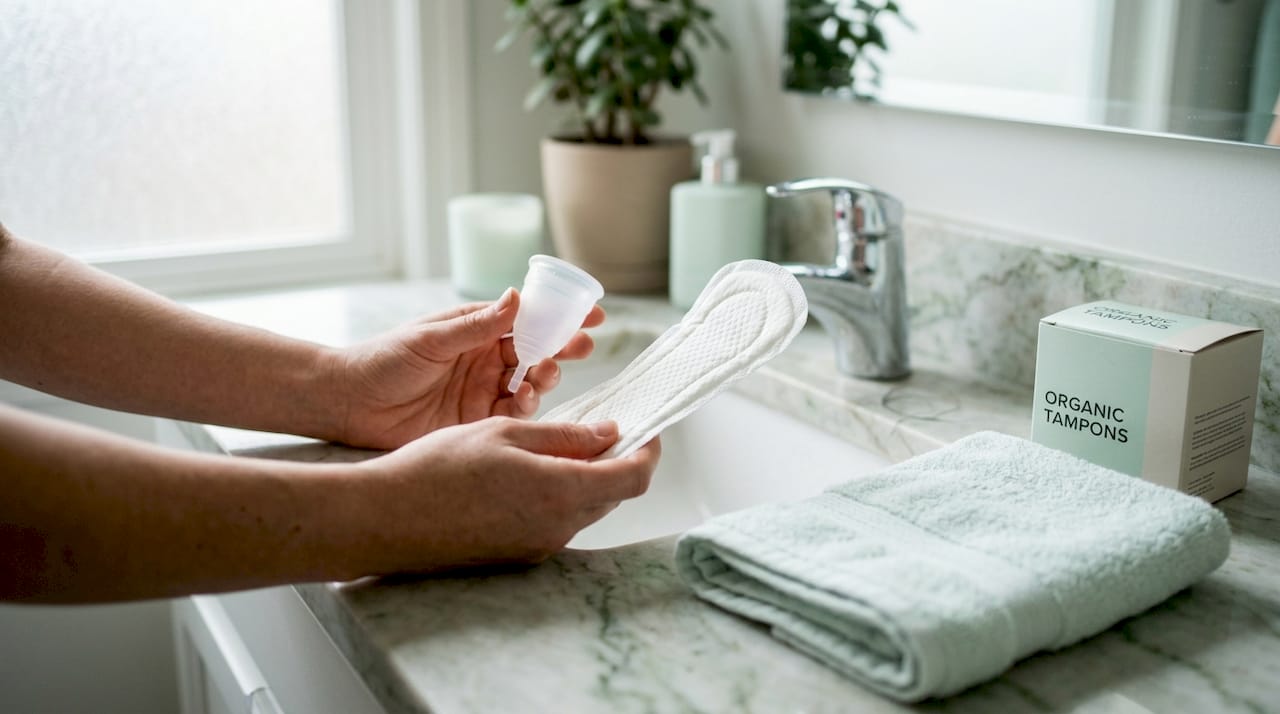
A practical selection approach starts with deciding whether you want an internal product like a cup, disc, or tampon, or a surface product like reusable pads or period underwear. Internal options tend to offer more freedom of movement and longer wear times. External options are often gentler for people with sensitivity or conditions like vaginismus.
Step 3: Match size and capacity to your flow
Flow levels vary enormously from person to person and even day to day. Light days may work well with a smaller tampon or liner, while heavy days may call for a higher-capacity cup or period underwear designed for overnight use. Consider natural menstrual care tips to learn how to track your flow accurately over a few cycles before committing to a single product.
Step 4: Verify certifications and ignore vague claims
Words like “pure,” “gentle,” and “plant-based” mean nothing without certification support. Check the product page or box for GOTS, OEKO-TEX, or comparable third-party validation. If a brand can’t name the certifying body, treat the claim skeptically.
Step 5: Consider a hybrid approach
Pairing products for different situations is one of the smartest moves you can make. Many people use a menstrual cup on heavier days and sustainable menstruation practices like reusable liners as backup. Organic cotton tampons might be your go-to for the office or gym while reusable pads handle evenings at home. Flexibility is not a compromise. It’s a strategy.
- Reflect on your activity level, flow, and access to washing facilities
- Choose internal or external product type as your starting filter
- Match absorbency and size to your flow and anatomy
- Confirm materials and certifications on the label
- Try one new product per cycle and keep notes on comfort and performance
- Build a personal combination routine based on what actually works for you
Pro Tip: Order a trial size or single-item purchase before buying a full supply of any new-to-you product. Your body’s feedback after one cycle is worth more than any product review.
Comparing top product types: Which is most sustainable?
With your personal needs in mind, see how key product styles compare across sustainability, comfort, and care routines.
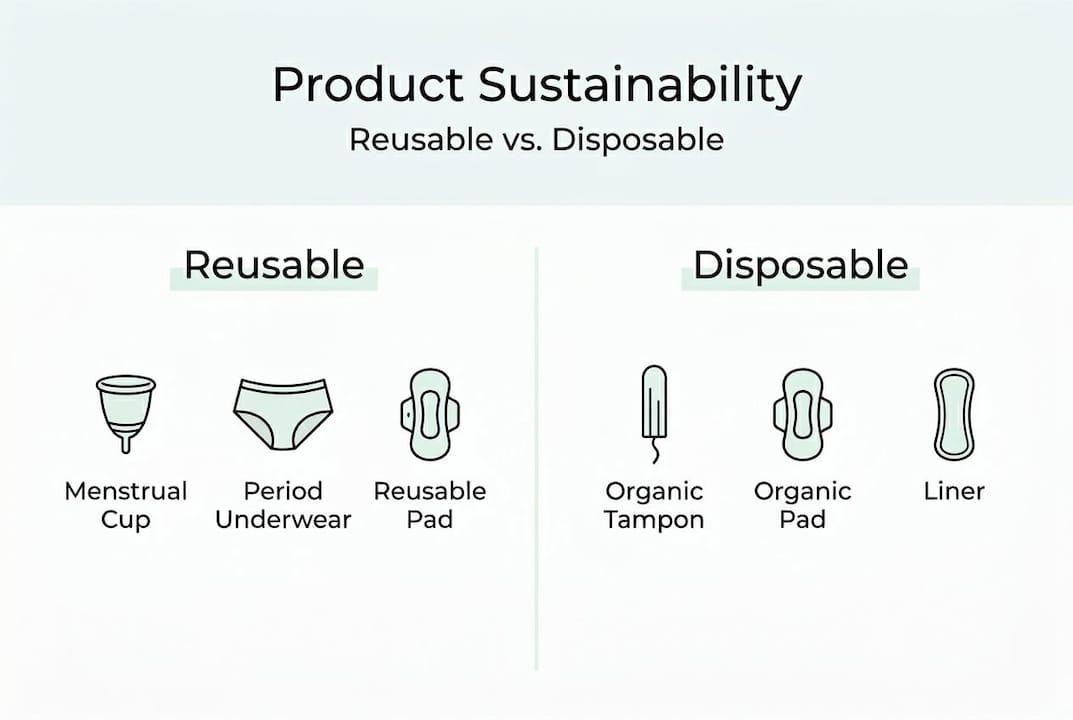
In a life-cycle comparison, menstrual cups rank as the top option across multiple environmental impact indicators, followed by period underwear and reusable pads, with disposable pads and tampons at the bottom. However, this ranking assumes consistent and responsible care practices, and that’s where real-world results can differ.
| Product type | Sustainability rank | Avg. lifespan | Care required | Best for |
|---|---|---|---|---|
| Menstrual cup | Highest | 5 to 10 years | Boiling/sterilizing | Active, eco-focused users |
| Period underwear | High | 2 to 5 years | Machine wash cold | Light to moderate flow |
| Reusable pads | High | 2 to 5 years | Cold rinse and wash | At-home comfort |
| Organic tampons | Moderate | Single use | None | Active lifestyles |
| Organic disposable pads | Lower | Single use | None | Beginners, backup |
Menstrual cups can last a decade with proper care, meaning one purchase replaces hundreds of disposables. That’s a significant reduction in both waste and long-term spending. The tradeoff is that cups require boiling or sterilizing between cycles, which uses water and energy. Your care routine genuinely matters for the overall environmental calculation.
Period underwear and reusable pads offer similar eco benefits at a lower learning curve than cups. The catch is that they need reliable access to cold-water washing and drying space. If you live in a dormitory, travel frequently, or have limited laundry access, these products may be less practical as a primary option.
Sustainability trade-offs are real: reusable products require washing, water, and energy, so the overall footprint depends on care practices. Combining options rather than forcing a single method for every scenario is often the most realistic and still genuinely sustainable path.
Organic cotton tampons and pads, while single-use, are a massive improvement over conventional disposables made with synthetic materials, dioxin-bleached cotton, and plastic applicators. They biodegrade faster and keep synthetic chemicals away from intimate tissue. For many people, they are the right primary option, especially when paired with a reusable backup. Understanding how period products affect the environment helps you make choices that align with your actual lifestyle rather than an idealized version of it.
- Menstrual cups: lowest long-term waste, highest upfront investment in technique
- Reusable pads and underwear: easy to start, require consistent washing habits
- Organic disposables: best eco step-up from conventional, no learning curve
- Hybrid combos: often the most practical and genuinely sustainable real-world approach
Pro Tip: Use an eco period product checklist to score your current routine and identify the easiest swap to make first, rather than trying to overhaul everything at once.
Special considerations for safety and comfort
Once you’ve narrowed the field, fine-tune your choice based on safety, comfort, and any personal health considerations.
Product safety is not just about materials. Fit, hygiene routine, and how your body responds to each product all matter just as much.
Getting sizing and material right
For menstrual cups specifically, key selection mechanics include choosing the correct size for comfort and leak prevention, selecting appropriate material such as silicone if you are sensitive to latex, and aligning capacity with your expected flow. Cups that are too large or too firm cause discomfort and leaks. A softer, smaller cup often works better for beginners or people with lower cervixes.
For external products, the material in contact with your skin is paramount. Organic cotton, certified free of dioxins and pesticides, is the gold standard for people with sensitive skin or eczema-prone tissue.
IUD compatibility
Menstrual cups can still be used with an IUD in place, but the risk management centers on technique during removal. Always break the suction seal completely before pulling the cup out. Regularly check your IUD strings after removal to confirm the device has not shifted. If your strings are unusually long, ask your provider about trimming them to reduce any potential interaction.
Tracking your body’s response
- Introduce one new product at a time so you can identify the source of any irritation
- Note any redness, itching, or unusual discharge that appears after switching products
- If you develop recurring issues with one material or product type, try a different material before giving up on the category entirely
- Ask your gynecologist about health-conscious menstrual options if you have a specific condition like endometriosis, vaginismus, or latex sensitivity
Important: Hygiene matters as much as eco-credentials. Change and clean products on the schedule recommended by the manufacturer. A natural product used incorrectly still carries health risks.
What most guides miss about choosing natural period products
Here is an uncomfortable truth about most period product guides: they treat sustainability like a competition with a single winner. Menstrual cup wins. Everyone else is doing it wrong. That framing is not only unhelpful, it actively pushes people away from making any positive change at all.
The reality we’ve seen again and again is that even the most committed eco-minded people mix methods. Your camping trip is not the place to figure out menstrual cup insertion for the first time. A heavy, crampy first day may genuinely call for the ease of an organic tampon rather than the mental overhead of an unfamiliar reusable. And that is completely fine.
What nobody talks about enough is how period product preferences shift throughout your life. Products that worked perfectly at 22 may feel wrong at 32, especially after childbirth, hormonal changes, or significant shifts in fitness level and anatomy. The cup size that fit before may not fit after. The period underwear that felt life-changing in summer may be too bulky for winter clothing. Giving yourself permission to reassess every year or two is not inconsistency. It’s smart self-care.
The most sustainable choice is also the one you’ll actually stick to. A menstrual cup sitting unused in a drawer because it never felt comfortable generates zero environmental benefit. An organic tampon used consistently, cycle after cycle, is a genuine contribution to reducing chemical exposure and plastic waste.
We believe the sustainable period brands worth trusting are the ones that encourage you to find your own mix rather than prescribing a rigid routine. Real sustainability is built on long-term habits, not perfect single choices.
Explore organic and sustainable period solutions with Tampon Tribe
You’ve done the thinking. Now make it real with products that actually back up their claims.
At Tampon Tribe, every product in our line, from certified organic tampons to reusable menstrual cups and organic teen pads, is built to meet rigorous standards for natural materials and genuine sustainability. Our packaging is 100% plastic-free because we mean it when we say we’re saving the turtles. Whether you’re building your first natural period routine or refining one you’ve had for years, our product guides and subscription options make it easy to match the right combination to your body, your flow, and your values. Start with one swap, and let your comfort lead the way.
Frequently asked questions
What are the safest natural period products for sensitive skin?
Look for products made from 100% organic cotton with no added dyes, fragrances, or synthetic materials, and confirm certifications to make sure what touches your skin has been independently tested for safety.
How can I confirm a product is genuinely eco-friendly?
Check for independent certifications like GOTS or OEKO-TEX rather than relying on marketing language, and review the product’s full life cycle including packaging and care requirements rather than only the material composition.
Can menstrual cups be used with an IUD?
Yes, with the right technique. Always break the suction completely before removal and check your IUD strings regularly to ensure no displacement has occurred.
What if my flow changes during my cycle?
Adjust your product choice by day rather than committing to a single option throughout your period. Mixing absorbency levels and product types gives you personalized coverage that a single product simply can’t match.
Is washing reusable period products truly sustainable?
Generally yes, reusable options produce significantly less waste over time, but the overall footprint depends on how you wash them, such as water temperature, machine versus hand wash, and local energy sources.