


Most people assume that slapping an “organic” label on a tampon or pad makes it automatically safe, pure, and planet-friendly. That assumption is understandable — but it’s not entirely accurate. Some period products labeled ‘organic’ may still contain chemicals introduced during manufacturing, through additives, or via packaging materials. That doesn’t mean organic products aren’t worth choosing — they absolutely can be. But making a truly informed choice means understanding what the organic label actually covers, where its limits are, and which details to look for beyond the label itself.
Table of Contents
- What does ‘organic’ mean in period products?
- Health benefits and safety: What the evidence actually shows
- Reducing environmental impact: Does organic make a difference?
- Key ingredients, chemicals, and label pitfalls to watch for
- The uncomfortable truth about organic period products
- Discover better period products with Tampon Tribe
- Frequently asked questions
Key Takeaways
| Point | Details |
|---|---|
| Organic isn’t always chemical-free | Organic period products reduce some risks, but chemicals can still be present from manufacturing. |
| Health benefit is fewer irritants | The strongest evidence is for avoiding added dyes, fragrances, and unnecessary chemicals. |
| Environmental impact varies | Organic reduces pesticide use but true sustainability requires full supply chain improvements. |
| Transparency empowers better choices | Always check for honest labeling, third-party test results, and detailed ingredient lists. |
| Balanced knowledge beats marketing | No product is perfect—an informed, label-savvy approach gives you the healthiest, most eco-friendly results. |
What does ‘organic’ mean in period products?
When a period product calls itself “organic,” it almost always refers to how the cotton or fiber used in the product was grown. Certified organic cotton is cultivated without synthetic pesticides, herbicides, or genetically modified seeds. That’s genuinely meaningful because conventional cotton farming is one of the most pesticide-heavy agricultural systems in the world.
But here’s where things get more complicated. Growing organic cotton is just the first step in a long production chain. After harvest, fibers go through ginning, spinning, bleaching, and often dyeing or finishing processes. Packaging introduces another set of variables entirely. The organic period products explained breakdown makes this clear: organic certification typically governs the raw fiber, not the complete finished product.
The FDA does provide some oversight of menstrual products as medical devices, requiring manufacturers to meet safety standards. However, regulations don’t yet require full ingredient disclosure for period products in the United States, which means two “organic” products on the same shelf could have very different chemical profiles.
| Feature | Conventional products | Organic-labeled products |
|---|---|---|
| Cotton source | Likely conventional, pesticide-treated | Certified organic cotton |
| Bleaching process | Often chlorine-based | Ideally peroxide/oxygen-based |
| Fragrance/dye use | Common | Varies widely by brand |
| Full ingredient disclosure | Rarely required | Rarely required |
| Packaging materials | Usually plastic | Varies; some brands use zero plastic |
| Third-party certification | Uncommon | Sometimes, but not universal |
Key finding: Research published in 2026 confirms that certain chemicals remain present in some organic-labeled menstrual products, stemming from manufacturing inputs and packaging rather than the fiber itself. The organic label alone is not a guarantee of a chemically clean end product.
This doesn’t mean organic products are a marketing trick. It means you need to understand the label as a starting point, not a finish line.
Health benefits and safety: What the evidence actually shows
Now that you know organic doesn’t always mean “free from everything,” let’s look at the concrete health impacts. The vaginal tissue and skin in the vulvar area are highly permeable — meaning they can absorb substances more readily than many other body surfaces. Spending several days a month with a product in direct contact with that tissue is genuinely relevant to health, which is why ingredient awareness matters.
The most well-supported health argument for organic period products is the reduction of unnecessary chemical exposure, particularly from fragrances and synthetic dyes. Clinicians and researchers at institutions like Brigham and Women’s Hospital highlight that reducing fragrance and dye exposure is the most evidence-aligned health benefit. For people with sensitive skin, vulvar dermatitis, or existing conditions like endometriosis, eliminating these irritants can make a real, noticeable difference in comfort.
Here are the top evidence-backed reasons people choose organic period products:
- Fewer fragrances: Synthetic fragrances are among the most common contact irritants and allergens in personal care products
- No synthetic dyes: Colorants have been associated with skin reactions, particularly in sensitive individuals
- Reduced pesticide residue risk: While research is still evolving, choosing products made from organically grown fibers at minimum limits one route of potential exposure
- Non-chlorine bleaching: Chlorine bleaching can produce dioxins, which are persistent environmental contaminants with long-term health concerns
- Better ingredient transparency: Brands committed to organic standards are often more willing to disclose what’s in their products
It’s equally important to be honest about what the current evidence does not show. There is no strong, widely accepted scientific consensus that switching to organic period products will reduce the risk of reproductive cancers or other major diseases for the average person. The risk factors for those conditions are complex, and isolating tampon chemicals as a primary driver isn’t supported by current data.
Pro Tip: Always cross-check products against their full ingredient list, not just the front-label claim. Look for the word “unscented” rather than “fragrance-free light scent,” and verify certification details on the brand’s website.
Your best practical strategy is to prioritize products that are fragrance-free, dye-free, and made with certified organic cotton. A chemical-free tampon guide can help you decode the ingredient language and narrow down products that meet these standards. When in doubt, brands that proactively share their full ingredient lists are more trustworthy than those that don’t, regardless of what the front label says. Exploring health-conscious menstrual options side by side can also reveal which certifications carry the most weight.
Reducing environmental impact: Does organic make a difference?
Just as with health benefits, the eco story of “organic” period products is more nuanced than labels suggest. Life-cycle assessment research demonstrates that environmental impact depends on the full system, not simply whether the raw input is organic. This means a product made from organic cotton but wrapped in layers of plastic may still produce a significant environmental footprint by the time it reaches landfill.
That said, organic cotton agriculture does deliver measurable improvements in specific environmental categories. Eliminating synthetic pesticides and fertilizers protects soil health, reduces chemical runoff into waterways, and lowers the toxin burden on farmworkers and surrounding ecosystems. Those are real wins.
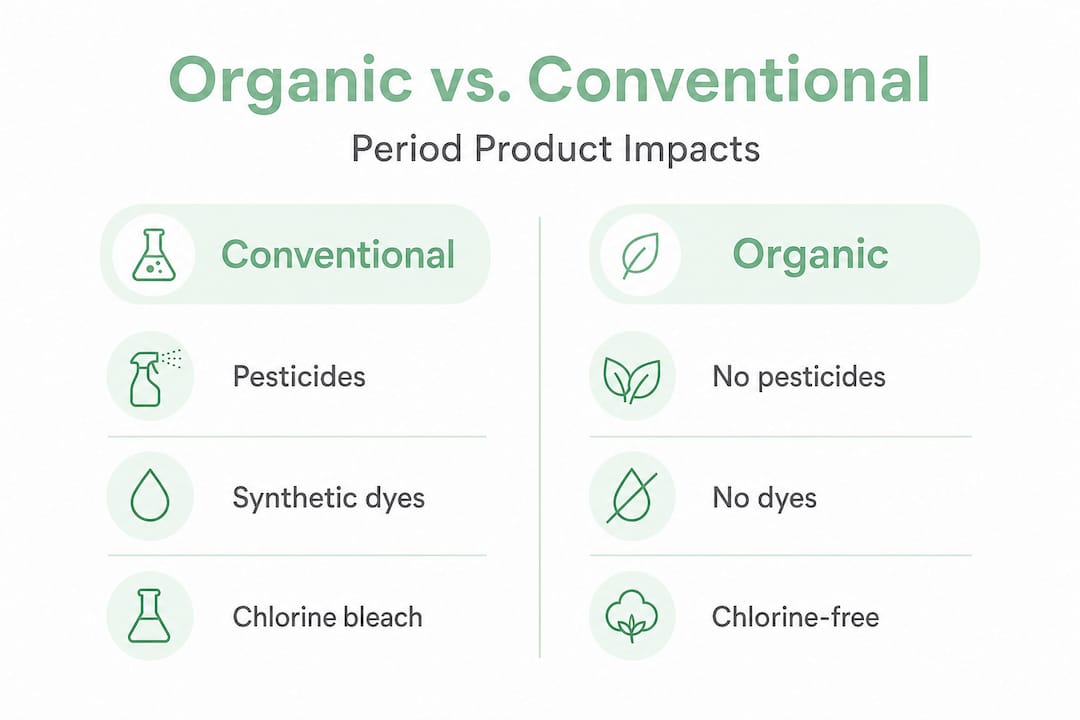
| Impact category | Conventional period products | Organic-labeled period products |
|---|---|---|
| Agricultural pesticide use | High | Low to none |
| Synthetic fertilizer load | High | Low |
| Bleaching chemical byproducts | Potentially high (chlorine) | Lower (peroxide/oxygen) |
| Packaging waste | Predominantly plastic | Varies; some brands use zero plastic |
| End-of-life (landfill) | Slow degradation | Similar unless fully compostable |
| Carbon footprint | Depends on full supply chain | Depends on full supply chain |
The packaging question is one most “organic” brands quietly underplay. A tampon made from certified organic cotton wrapped in a plastic applicator and sealed in a plastic bag is still contributing significantly to plastic pollution. That’s why brands that invest in eco-friendly menstrual options with plastic-free packaging represent a more holistically sustainable choice.
Here are concrete steps for making a greener period choice:
- Check the fiber certification: Look for GOTS (Global Organic Textile Standard) certification, which covers both fiber production and some manufacturing standards
- Examine the packaging: Is it paper-based, plastic-free, or compostable? The outer packaging is often the biggest end-of-life waste contributor
- Ask about bleaching processes: Oxygen or hydrogen peroxide bleaching is far preferable to chlorine-based methods
- Research the brand’s supply chain: Transparent brands publish details about where and how their products are made
- Consider the applicator: Cardboard applicators biodegrade significantly faster than plastic ones; applicator-free options minimize waste further
Checking out green period products comparisons can help you evaluate brands across all of these dimensions rather than relying on a single label claim.
Pro Tip: Third-party certifications like GOTS, OEKO-TEX, or MADE SAFE are among the strongest signals of genuine eco-credibility. If a brand can’t name the certifications its products carry, that’s worth noting before you buy.
Key ingredients, chemicals, and label pitfalls to watch for
Even after choosing organic, understanding what’s on the label can make a big difference for your health and the environment. The period care industry still operates in a regulatory environment that doesn’t mandate full ingredient disclosure in the U.S., so you have to do a little detective work.
The bleaching method matters more than many shoppers realize. Chlorine bleaching of cotton can produce dioxins, a class of persistent organic pollutants that accumulate in body tissue and the environment. Non-chlorine bleaching reduces dioxin formation substantially, and when a brand uses oxygen or hydrogen peroxide bleaching, that is one of the most meaningful safety improvements they can make, often more meaningful than the organic cotton distinction alone.
Watch out for these four common label pitfalls:
- “Natural” or “plant-based” claims: These terms are not regulated the same way “organic” is. A product can market itself as natural while containing synthetic fragrances, preservatives, or bleached fibers without any certification
- “Fragrance” as a catch-all: The word “fragrance” on a label can legally represent dozens of undisclosed chemical compounds. Always choose “unscented” products with no fragrance listed at all
- Partial certifications: A product might certify only the outermost cotton layer while using conventional materials for its inner core, backing, or adhesive. Read the fine print on what specifically the certification covers
- “Hypoallergenic” without evidence: This term has no regulated definition in the U.S. and doesn’t guarantee a product is free of known allergens or irritants
Expert finding: Research consistently shows that non-chlorine bleaching is one of the most impactful choices a manufacturer can make for safety. Yet many products use the word “organic” to signal safety while quietly maintaining chlorine-based processing. The word “organic” is most meaningful when it also implies the avoidance of chlorine bleaching, full ingredient transparency, and third-party verification.
For a thorough breakdown of what to look for beyond the surface, safe and sustainable menstrual products resources can guide your assessment of specific brands.
The uncomfortable truth about organic period products
Here’s what most brands — including some organic ones — rarely say out loud: the “organic” label can function as a marketing shortcut as much as a genuine safety standard. Telling someone their product is organic feels satisfying. It suggests care, intention, and purity. And in many cases, it does reflect real improvements over conventional options. But the narrative gets oversimplified very quickly.
The real issue is that consumers are often asked to choose between trusting a label or feeling overwhelmed by chemistry they didn’t study. Neither extreme serves you well. What actually serves you is label literacy: knowing which certifications matter, which terms are regulated, and which claims are meaningful versus decorative.
Clinicians who study this area are clear that organic can reduce certain inputs while some contaminants may still occur through manufacturing pathways outside the scope of organic certification. That’s not a reason to give up on organic products. It’s a reason to ask better questions of the brands you support.
The most empowering thing you can do isn’t to find the “perfect” organic product — it’s to support brands that are genuinely transparent, and to vote with your purchases for full ingredient disclosure and third-party verification. Companies that share exactly what’s in their products, how they’re made, and which certifications cover which parts of the process deserve your trust more than those hiding behind vague “natural” claims.
Exploring organic period products impact from a holistic lens — health, environment, manufacturing, and accountability — gives you a much richer frame for decision-making than the label alone ever could. Aim for knowledge-based choices, not perfectionism. That’s where real progress lives.
Discover better period products with Tampon Tribe
Ready to find period products that match your health values and sustainability standards without the guesswork?
At Tampon Tribe, every product is built around the kind of transparency this article describes: certified organic cotton, non-chlorine bleaching, zero plastic packaging, and no synthetic fragrances or dyes. When you switch to natural tampons, you’re not just making a health-conscious choice for yourself — you’re reducing plastic waste and supporting a brand that publishes exactly what goes into its products. Browse the full range of organic cotton tampons to find the right absorbency, applicator style, and subscription option that fits your cycle and your values. Your period doesn’t have to be a compromise.
Frequently asked questions
Are organic period products completely chemical-free?
Not always — organic products often reduce certain chemicals, but some may still be present from manufacturing processes or packaging materials.
What is the main health benefit of choosing organic period products?
The best-supported benefit is reducing exposure to unnecessary irritants like fragrances and dyes, which clinicians identify as the most evidence-aligned rationale for choosing organic.
Do organic period products have a smaller environmental footprint?
They typically reduce pesticide use significantly, but the full environmental footprint depends on the entire system including processing, packaging, and disposal.
Is it important to avoid chlorine-bleached pads and tampons?
Yes — non-chlorine bleaching reduces dioxin formation, making oxygen or hydrogen peroxide-bleached products preferable for both health and environmental reasons.
What should I look for on organic period product labels?
Prioritize full ingredient lists, recognized third-party certifications like GOTS or OEKO-TEX, and avoid any product that lists “fragrance” as an ingredient or uses vague terms like “natural” without certification to back it up.