


Choosing a menstrual product when you genuinely care about your body and the planet can feel overwhelming. The shelves and search results are packed with claims like “natural,” “eco-friendly,” and “clean,” but those words don’t always mean what you think. Understanding the real differences between options, from menstrual cups to organic tampons, puts you back in the driver’s seat. This guide walks through every major product type, the science-backed criteria that actually matter, and how to match your choice to your unique life so you can move forward with confidence.
Table of Contents
- How to evaluate menstrual products for sustainability and health
- Reusable menstrual cups and discs
- Period underwear and reusable cloth pads
- Organic disposable pads and tampons: a better single-use option?
- What to consider: flow, sensitivity, lifestyle, and accessibility
- Why the “perfect” menstrual product doesn’t exist, and that’s empowering
- Find your perfect match for a greener cycle
- Frequently asked questions
Key Takeaways
| Point | Details |
|---|---|
| Reusable wins for environment | Menstrual cups and period underwear cut waste and impact more than any disposable option. |
| Certifications matter | Choose GOTS or OEKO-TEX certified products for real organic and safety assurances. |
| Comfort and fit are personal | Try different types to find what suits your body, lifestyle, and flow best. |
| No shame in mixing methods | Combining reusables and disposables is sustainable and practical for different situations. |
| Better choices start with knowledge | Understanding your options helps you make a greener, healthier, more confident period product decision. |
How to evaluate menstrual products for sustainability and health
To help you navigate the array of options, let’s start with how to judge what matters most in a menstrual product.
Most people pick their period products out of habit, convenience, or whatever their mom bought. But once sustainability and health become priorities, the decision gets more nuanced and far more interesting. The good news is that a clear evaluation framework makes it simple.
Start with certifications, not marketing copy. The Global Organic Textile Standard (GOTS) and OEKO-TEX Standard 100 are the two most respected third-party certifications for textile-based period products. GOTS covers the entire supply chain from farming to finished product, while OEKO-TEX tests for harmful substances. These GOTS/OEKO-TEX certifications matter far more than vague “natural” claims on packaging, and reusable products break even environmentally after just one to three months of regular use.
Consider the full life cycle. Single-use products create waste every cycle, while reusables require water, energy, and detergent for washing. Neither category is perfect, but life cycle analysis (LCA) research consistently shows that reusables have a significantly smaller footprint over time.
Here’s a quick checklist for evaluating any period product you’re considering:
- Ingredients: Is it made from organic cotton, medical-grade silicone, or certified bamboo? Or does it contain synthetic fragrances, dyes, and chlorine bleach?
- Certifications: Does it carry GOTS, OEKO-TEX, or FDA-clearance for internal products?
- Waste profile: How many units will you go through in a year? In a decade?
- Sensitivity: Does your skin react to synthetic fabrics or fragrances?
- Lifestyle fit: Will you be camping, traveling, or working long shifts where changing frequently isn’t easy?
Pro Tip: When a product’s website lists “natural” ingredients without a third-party certification to back it up, treat it like an unverified claim. Real certifications have audit trails.
Exploring eco-friendly period choices in depth can also help you build intuition about what labels actually deliver on their promises.
Reusable menstrual cups and discs
Now that you know what to look for, let’s explore your first reusable option: menstrual cups and discs.
Menstrual cups and discs are often the first thing that comes to mind when people think about sustainable period care, and for good reason. These two products share a reusable DNA but work quite differently inside the body.
A menstrual cup is made from medical-grade silicone, inserted into the vaginal canal where it creates a light suction seal just below the cervix. It holds 20 to 30mL of fluid and can be worn safely for up to 12 hours. With proper care, a single cup lasts five to ten years, preventing thousands of disposables from reaching landfills and oceans.
A menstrual disc sits higher in the body, resting behind the pubic bone in the vaginal fornix (the wider space just before the cervix). Because it doesn’t rely on suction, it’s generally considered safer for IUDs and can hold up to 70mL, making it an excellent option for heavy flow days. Discs also make period sex possible for many users, a feature cups simply can’t offer.
Key advantages at a glance:
- Longevity: One cup or disc for up to 10 years
- Capacity: Discs hold more than most other products on the market
- Cost savings: Initial investment pays off within a few cycles
- Minimal waste: No packaging, no applicators, no wrappers
The honest tradeoff is the learning curve. Most users need one to three full cycles to get comfortable with insertion and removal. Not every anatomy fits every cup size or shape, so it may take some trial and error to find your match. Learning curve aside, the menstrual products that matter most for long-term sustainability tend to be the ones with the longest usable lifespan.
One important note: Toxic Shock Syndrome (TSS) is a rare but serious bacterial infection. It’s often associated with tampons, but the risk applies to any internal product left in too long. Always follow the recommended wear time, wash your cup or disc thoroughly between uses, and see a doctor immediately if you notice symptoms like sudden fever, rash, or dizziness.
Pro Tip: Boil your silicone cup for five minutes at the end of each cycle to sanitize it properly. Store it in a breathable cotton pouch, never an airtight container.
Period underwear and reusable cloth pads
If you like wash-and-wear solutions, let’s see how period underwear and cloth pads stack up.
Period underwear has quickly moved from niche product to mainstream essential. The design is elegantly simple: multiple layers of fabric are sewn directly into underwear that looks and feels almost identical to regular underwear. The inner layer wicks moisture away, a middle layer absorbs blood, and an outer layer prevents leaks.
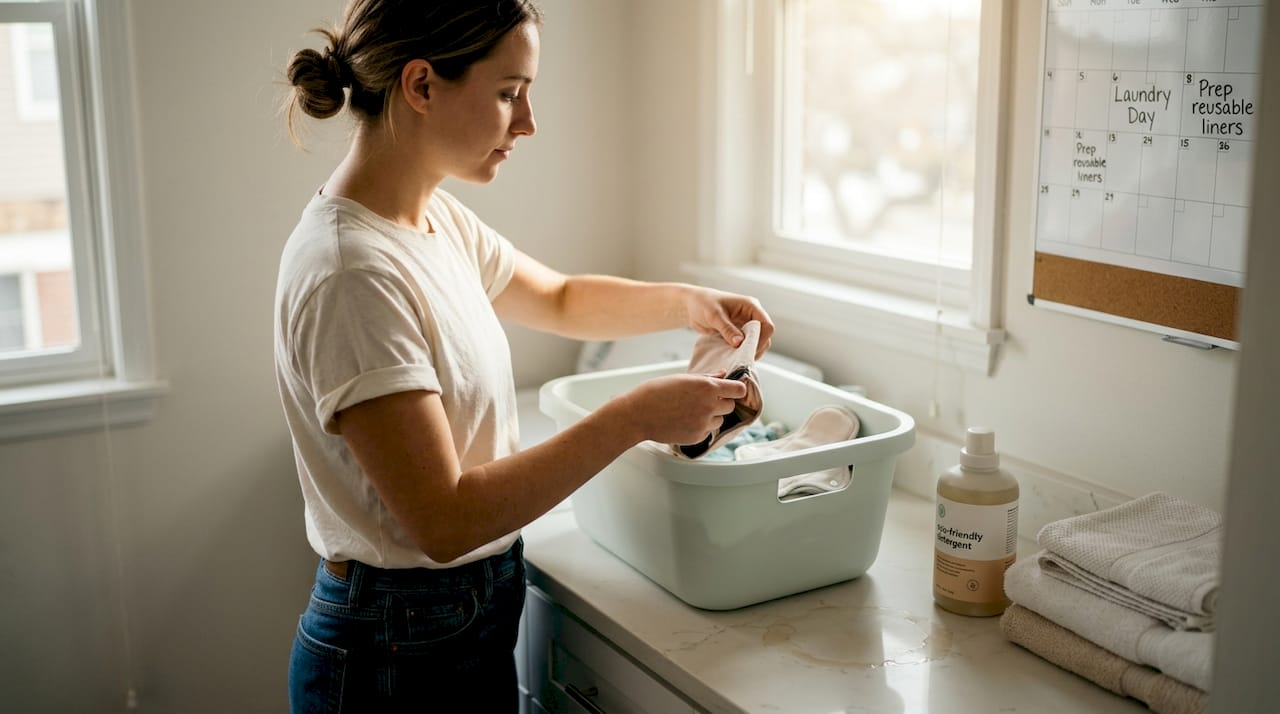
Reusable cloth pads work on the same principle but attach to your regular underwear with snap fasteners. According to life cycle research, these pads are typically made from layered organic cotton, bamboo, or hemp with a PUL (polyurethane laminate) backing for leak protection. You wash them after use and they last three to five years with proper care.
Here’s how these two options compare side by side:
| Feature | Period underwear | Reusable cloth pads |
|---|---|---|
| Ease of use | Wear like regular underwear | Snap onto underwear |
| Absorbency options | Light to heavy by style | Customizable by layer count |
| Best for | All-day wear, teens, overnight | Home use, light to medium flow |
| Lifespan | 2 to 5 years | 3 to 5 years |
| Care | Cold machine wash, line dry | Cold rinse, machine wash |
| Learning curve | None | Minimal |
From an environmental standpoint, life cycle analysis benchmarks rank period underwear and reusable pads well above organic disposables and conventional products, though just below menstrual cups on the sustainability scale.
Bamboo-based pads often come out ahead of cotton in LCA studies due to bamboo’s lower water usage and faster growth rate. However, processing bamboo into fabric does involve chemicals, so certification matters here too. Check for menstrual product environmental impact details before committing to any specific brand.
Pro Tip: Rinse cloth pads in cold water immediately after use to prevent staining. Hot water sets blood stains. A 30-minute cold soak before a machine wash on a cool cycle works brilliantly.
For more care advice, these natural menstrual care tips go deeper into product longevity and daily routines that work.
Organic disposable pads and tampons: a better single-use option?
For those times when reusable options don’t fit your life, let’s look at the most responsible single-use alternatives.
Let’s be honest: reusables aren’t always realistic. Travel, unexpected periods, health conditions, dormitory life without easy laundry access, these are all valid reasons why you might need a reliable disposable option. The question is whether organic disposables are meaningfully better than conventional ones.
The short answer is yes, with some nuance. Organic disposables are better than conventional products but are far from zero-waste, and some bamboo-based pads actually have a lower life cycle impact than organic cotton pads due to agricultural differences. That matters when you’re trying to make genuinely informed choices.
Conventional tampons and pads often contain synthetic fragrances, chlorine-bleached fibers, dioxin residues, and plastic components that never biodegrade. Organic cotton products eliminate the pesticides and chlorine, significantly reducing your chemical exposure and the toxic load going into landfills. Bamboo pads take it a step further in some environmental metrics.
| Product type | Chemical exposure | Waste profile | Environmental rank |
|---|---|---|---|
| Conventional pad/tampon | High (fragrances, bleach, plastic) | High plastic waste | Lowest |
| Organic cotton disposable | Low (certified fibers) | Biodegradable core, some plastic | Moderate |
| Bamboo disposable | Very low | Often compostable | Moderate to good |
| Reusable cup/disc | Minimal (medical silicone) | Nearly zero waste | Best |
Life cycle ranking based on LCA benchmarks comparing environmental impact across product categories.
Important stat: A person who menstruates uses approximately 11,000 to 17,000 disposable period products in their lifetime. Switching even partially to reusables or certified organic products makes a measurable difference over time.
For those who rely on disposables some or all of the time, understanding organic period product impacts is the first step. And if you want the bigger picture on plastic and water pollution, the period product environmental facts are eye-opening.
What to consider: flow, sensitivity, lifestyle, and accessibility
Now, let’s match these product options to personal needs and situations.
No product is universally perfect, and the right choice depends heavily on your flow, your body, your daily routine, and your access to facilities. Here’s a practical, real-world framework:
-
Heavy flow: Consider pairing a menstrual cup with a cloth pad or period underwear as a backup. Discs hold the highest capacity of any single product. Period underwear in a “heavy” absorbency level also works well for overnight protection.
-
Sensitive skin or vulvar conditions: Look for fragrance-free, dye-free, GOTS-certified organic cloth products. Period underwear made from organic cotton with no synthetic outer layer is typically the gentlest option for skin that reacts easily.
-
No laundry access: Organic disposables (pads or tampons) are a practical and far cleaner fallback than conventional products. Stock a small travel supply for trips or emergencies.
-
Teens and new menstruators: Period underwear or reusable pads often feel less intimidating than inserting a cup for the first time. Starting with external products builds familiarity and confidence before experimenting with internal options.
-
Active lifestyle or swimming: Menstrual cups and discs are hands-down the best option for sports, swimming, and high-activity days. They stay in place, don’t swell with water, and don’t require a trash bin mid-swim.
According to practical user guidance, cups and discs are not suitable for all anatomies or all IUD types. Discs are generally the safer choice if you have an IUD. Always consult your healthcare provider before switching to an internal product post-surgery or if you have any pelvic conditions.
Remember: Accessibility matters. Sustainable choices should fit real lives, not just ideal ones. Using organic disposables because that’s what works for your situation is genuinely better than using conventional products, even if it’s not the “most sustainable” option on paper.
Pro Tip: Build a small period kit for your bag: one or two organic tampons or pads for backup, a small bottle of soap for cup rinsing, and a spare set of period underwear. Being prepared means you’ll never have to grab the first thing you see at a gas station.
Looking into healthier period product options can help you figure out exactly which combinations work best for your specific routine.
Why the “perfect” menstrual product doesn’t exist, and that’s empowering
Having compared all the main options, let’s step back with some honest perspective to help you make your own best choice.
Here at Tampon Tribe, we’ve seen a tendency in the sustainable period space to push one product type as the singular “right answer.” Menstrual cups get evangelized. Reusables are sometimes held up as the only ethical option. Disposables get dismissed. We think this framing actually hurts more people than it helps.
The truth is that genuine sustainability comes from awareness and flexibility, not rigid rules. Someone using a menstrual cup at home and organic tampons while traveling is making a far better choice than someone guilt-tripping themselves into using a product that doesn’t fit their anatomy, lifestyle, or access. Real behavior change happens when the new option is actually easier or better in some meaningful way, not when it’s been assigned as the most virtuous choice.
Certifications and ingredients matter far more than buzzwords. “Natural” on a label means almost nothing without third-party verification. “Eco-friendly packaging” is meaningless if the product inside is laden with synthetic chemicals. Train yourself to look past the marketing and straight at the certification logos.
We also want to acknowledge that not everyone starts from the same place. Period poverty is real. Laundry access is not universal. Health conditions restrict what some people can use. A judgment-free approach to period care means meeting yourself where you are and building from there, not starting from shame. Understanding the clean period product benefits is a starting point, not a finish line.
The goal is progress, not perfection.
Find your perfect match for a greener cycle
Ready to make your pick? Here’s how Tampon Tribe can help you go further on your sustainability journey.
We built Tampon Tribe because finding genuinely clean, certified, plastic-free period products shouldn’t require a research degree. Every product we offer is rigorously selected for health, safety, and environmental responsibility, with no synthetic fragrances, no chlorine bleaching, and no plastic packaging hiding behind green-sounding labels.
Whether you’re ready to switch to natural tampons for the first time or you want to explore our full range of organic tampons and certified pads, we make it easy to find what fits your flow and your values. Our curated subscription boxes take the guesswork out of stocking up, so you always have what you need without the last-minute, grab-whatever’s-available moments. Your cycle deserves products that are as committed to your well-being as you are to the planet.
Frequently asked questions
Which menstrual product has the lowest environmental impact?
Menstrual cups consistently rank lowest in environmental impact across life cycle analyses, with one cup preventing more than 3,000 disposable products from entering landfills over its lifetime. Reusable pads and period underwear follow closely behind.
Are organic disposables much better than regular tampons and pads?
Organic disposables significantly reduce your exposure to pesticides, synthetic fragrances, and chlorine byproducts, but they still generate waste with every use. Some bamboo options show lower life cycle impact than conventional organic cotton pads, making them the better disposable choice.
Is it true that reusable period products are hard to clean?
Not at all. Most reusable pads rinse clean with cold water and machine wash on a cool or warm cycle. Washing full loads at lower temperatures also reduces the environmental impact of laundering, making the process both easy and genuinely green.
Can menstrual cups or discs cause Toxic Shock Syndrome (TSS)?
The TSS risk applies equally to all internal menstrual products if worn past the recommended time limit. It remains very rare, and consistent hygiene practices (proper washing, timely removal) nearly eliminate the risk entirely.
Recommended
- How menstrual products impact the environment: greener choices – Tampon Tribe
- Top health-conscious menstrual options for safer periods – Tampon Tribe
- Natural Menstrual Care Tips for a Healthier, Eco Period – Tampon Tribe
- Sustainable Menstruation: Eco-Friendly Choices for Healthier Cycles – Tampon Tribe